The skin is the largest organ in the body, and at the same time the one we pay the least attention to. Most people visit a dermatologist either with a cosmetic problem or when something is clearly wrong. A preventive examination allows you to notice changes at a stage when they are still easy to deal with.
May is Melanoma Awareness Month. A good reason to learn: what melanoma is, why it's dangerous, how to check your moles yourself, and when you need to see a doctor.
Why melanoma is serious
Of all skin cancers, melanoma accounts for only about 11% of all cases. The rest, basal cell and squamous cell carcinomas, are mostly curable and rarely metastasize. Melanoma behaves differently: it is aggressive, tends to spread quickly, and accounts for the majority of skin cancer deaths.
The main reason for such statistics is late diagnosis. In the early stages, melanoma looks like an ordinary mole. Without a special examination, it is almost impossible to distinguish it from a benign formation. That is why regular skin examination is not reinsurance, but a medical necessity.
How to check moles yourself – the ABCDE rule
Self-examination is a useful habit that helps you notice changes in time. Dermatologists recommend following the ABCDE rule:
A – Asymmetry. One half of the mole does not match the other in shape or size.
B – Border. Uneven, jagged, or blurred boundaries of the formation.
C – Color. Uneven color: several shades in one mole – brown, black, reddish, or white.
D – Diameter. More than 6 mm is about the size of a pencil eraser, although melanomas can be smaller.
E – Evolution · Changes. Any change in shape, color, or size over several weeks or months.
If there is at least one of these signs, it is a reason to consult a doctor in the near future. It is important to understand: self-examination does not replace an appointment with a dermatologist, it only helps to initiate it in time. The human eye sees the surface, but not the structure.
How often do you need to see a dermatologist?
The frequency of preventive examinations depends on individual risk factors.
Once a year – if there are no complaints, the skin does not change and there are no additional risk factors. This is the basic minimum for most adults.
Once every 6 months – if you have many moles, fair skin and eyes, a tendency to sunburn, or relatives with a history of melanoma.
Unplanned – if a new element has appeared on the skin, an existing formation has changed color or shape, has started to itch or bleed. In such cases, you should not wait for a scheduled visit.
If you haven't been to a dermatologist for a long time or have doubts about a specific lesion - Make an appointment with a dermatologist at Forest Retreat Center. The appointment lasts 40–60 minutes and includes a diagnosis of skin, moles, hair, and nails using dermatoscopy and hardware examination methods.
What is dermatoscopy and how does it work?
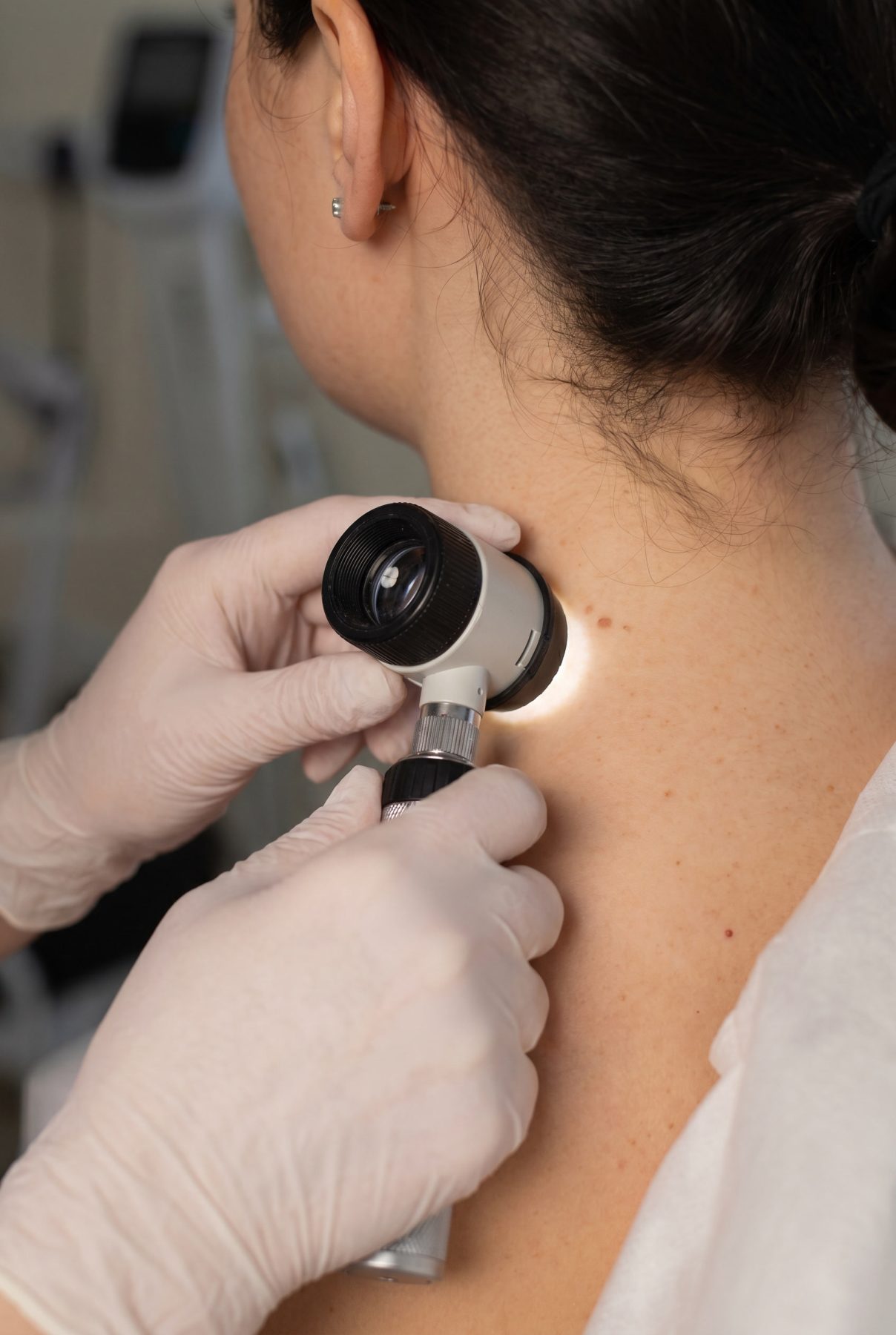
Dermatoscopy – painless, non-invasive examination of moles, age spots and skin neoplasms under high magnification using a special optical device – a dermatoscope. The procedure allows the doctor to see the structure of the formations at the micro level, assess their condition and detect potentially dangerous changes long before they become visible to the naked eye.
During the examination, the doctor may also take photographs to further compare the results over time – this is especially important for people with a large number of moles to track any changes between visits.
One dermatoscope appointment provides more diagnostic information than years of self-observation.
What to do if your doctor recommends removal
Sometimes, after dermatoscopy, the doctor recommends removing the formation – prophylactically or due to suspected atypicality. At Forest Retreat Center, this can be done immediately, without additional referrals.
Removal of papillomas, moles and other skin elements is performed using a radio wave method – without a scalpel, with minimal tissue trauma and short recovery. Most benign lesions are removed in one visit, the procedure takes from 15 minutes. If there are doubts about the nature of the lesion, a punch biopsy is performed at the same time with subsequent histopathological examination.
Skin diagnostics at Forest Retreat Center
A dermatologist-surgeon is available at Forest Retreat Center. He will assess the condition of the skin, give a clear recommendation for each formation, and, if necessary, perform removal.
Dermatologist consultation – comprehensive appointment with diagnostics of skin, moles, hair and nails. Duration 40–60 minutes, cost 1850 UAH, repeat consultation – 1600 UAH.
Dermatoscopy of skin elements – separate examination of specific formations. From 400 UAH for 1–4 elements, 750 UAH for 5–8 elements, 1300 UAH for a general examination of more than 8 elements. Duration – 15–30 minutes.
Removal of papillomas, moles and other elements – radio wave method, from 900 UAH for one element up to 5 mm.
All this takes place in the Holosiivskyi Forest - in a calm environment, without queues and haste.
Check your skin before summer
May, with its increased solar activity, is the best time for a routine checkup. If you have moles that you have been observing for a long time, or something has recently changed, don't delay.
Make an appointment for dermatoscopy